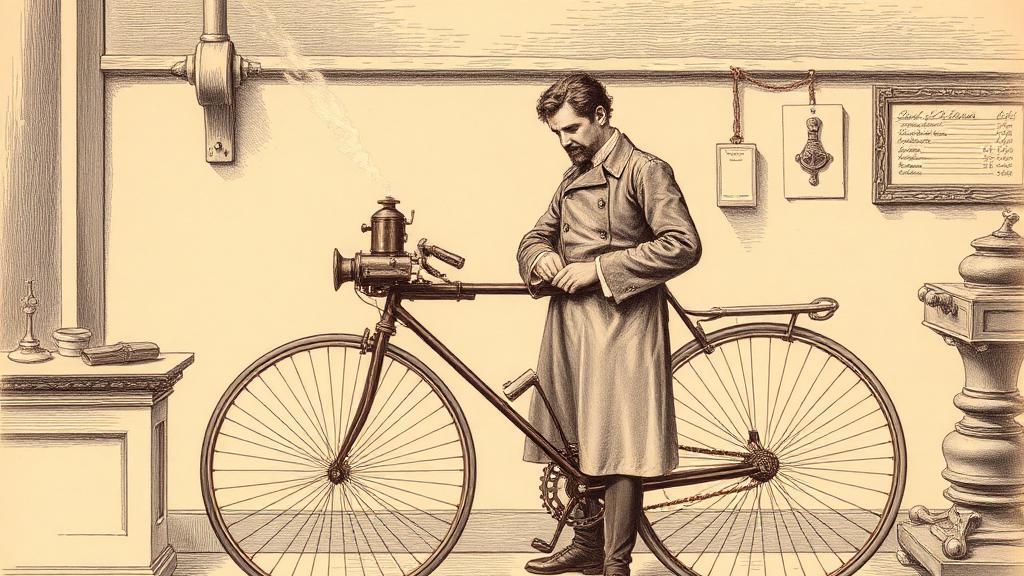
Perreaux's steam velocipede
Sometime in 1871, in a Paris workshop, Louis-Guillaume Perreaux bolted the frame of a Michaux boneshaker bicycle to a brass-plated single-cylinder steam engine, lit the alcohol burner beneath the saddle, and created a machine that weighed 87 kilograms, had no brakes, and was probably impossible to steer at speed. He had been working toward this for at least three years. Patent number 83,691, filed with the French Imperial Patent Office on December 26, 1868, had already described something very like it on paper.
Perreaux was 52 years old in 1868 and not a man who lacked for ideas. Born in 1816 in Almenêches, a village in Normandy, he had built a cane gun at age 12, trained at the École des Arts et Métiers at Châlons-sur-Marne, and spent the following decades filing patents across disciplines that had almost nothing to do with each other: a multi-chambered gun, a circular power saw, a lock mechanism, and — the one that made his name in engineering circles — a dividing machine capable of measuring to within a thousandth of a millimetre. He was a precision man who built a machine that shook itself to pieces.
The velocipede he chose as his base was a Michaux, the dominant French bicycle of the era — a heavy iron frame, iron-covered wooden wheels, no suspension, and pedals on the front axle, which is why riders called it a boneshaker. Perreaux mounted his engine above the rear wheel and drove it via twin leather belts. The single-cylinder engine displaced about 30 cc, produced between one and two horsepower, and ran on alcohol. The 1871 patent addition removed the front-wheel cranks and pedals entirely, leaving the rider with nothing to do but manage the fire and try not to fall off. Top speed: approximately nine miles per hour.
Here is the part worth sitting with. Researchers who examined the surviving machine — it lives today at the Musée de l’Île-de-France at the Château de Sceaux, outside Paris — believe it was likely never ridden in the conventional sense. The frame was too flexible, the center of gravity too high, the whole assembly too unstable for open-road use. The most plausible operating scenario is that Perreaux demonstrated it by tethering it to a central post in a horse ring and letting it circle at the end of a pivoting rod. The world’s first motorcycle patent may have covered a machine that went nowhere but in circles.
And yet. In the summer of 1998, when the Solomon R. Guggenheim Museum staged its exhibition “The Art of the Motorcycle,” the curators placed this machine — on loan from Sceaux — as the first object visitors encountered upon entering the rotunda. Three hundred thousand people filed past it in the three months the show ran. The Perreaux was chosen because it has something the Roper steam velocipede, its American contemporary, does not: a dated patent. Hugo Wilson, then editor of Classic Bike, put it plainly: because Perreaux had documents to verify his date, his machine had a stronger claim, however contested, to being first.
What Perreaux’s patent actually established was a concept, not a product. It said: a bicycle plus a heat engine is a thing worth protecting. Within sixteen years, Gottlieb Daimler and Wilhelm Maybach would prove the concept right, with a lighter engine, controlled combustion, and a machine that could be ridden without a tether. Every motorcycle since has been, in some sense, a refinement of the same drawing Perreaux filed on the day after Christmas, 1868.
The boilers got better. The brakes came later.
Sources
- Michaux-Perreaux steam velocipede — Wikipedia — Technical specifications, patent dates, the 1998 Guggenheim exhibition, and the three-way “first motorcycle” debate.
- Louis-Guillaume Perreaux — Wikipedia — Biography, early inventions, the dividing machine, and details of patent 83,691.
- No Longer Unique: a Pair of Perreaux — The Vintagent — The assessment that the machine was likely demonstrated on a tether rather than ridden, and the history of the surviving machine at Sceaux.