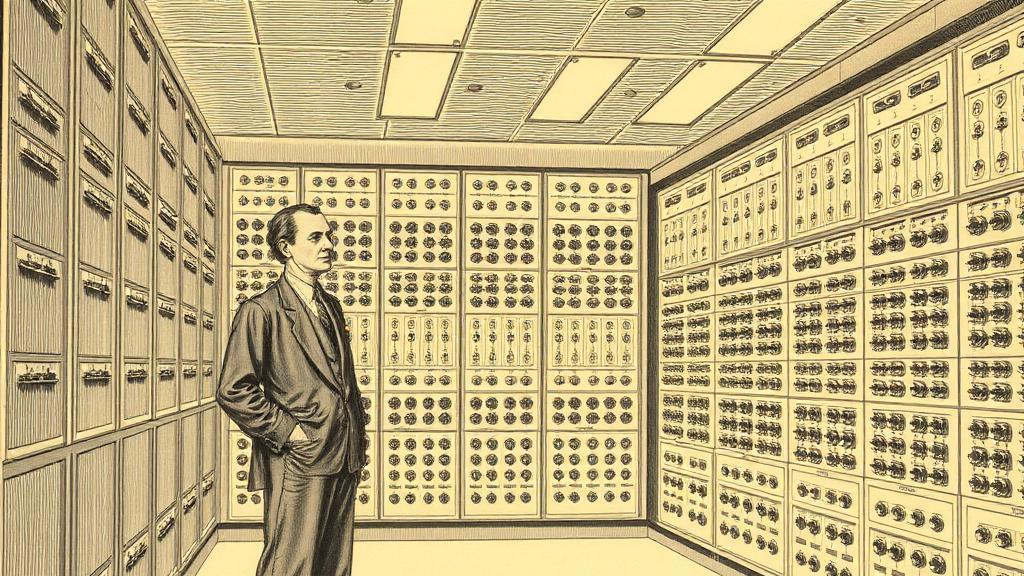
Harvard Mark I: the machine that took up a wall
The machine that arrived at Harvard’s Cruft Hall in February 1944 looked less like a computer and more like the inside of a watch factory scaled up to the size of a room: fifty-one feet of steel frames and polished glass panels, driven by a five-horsepower motor turning a single shaft that ran the full length of the floor. Every relay, every counter, every clutch in the system took its timing from that shaft. The name on the blueprints was the IBM Automatic Sequence Controlled Calculator. The name that stuck was the Harvard Mark I.
Howard Aiken had been chasing this idea since 1935, when he was a Harvard physics doctoral student grinding through differential equations by hand and running out of patience with the process. He wrote a proposal in 1937 and spent two years shopping it to calculator manufacturers, most of whom said no. IBM finally agreed, assigning engineers Clair Lake and Frank Hamilton to the project at their plant in Endicott, New York. The machine was completed in early 1943, crated, shipped, and installed at Cruft Hall by February 1944. It stood 8 feet tall and weighed 9,445 pounds. Its innards held 765,000 electromechanical components, 3,500 relays, and roughly 500 miles of wire.
The Mark I read its instructions from a punched paper tape prepared in advance. An operator loaded the tape; the machine followed the program without further intervention — multiplication in about six seconds, division in about twelve. It calculated to 18 significant decimal places, three times the precision of contemporary IBM office calculators. Beginning in May 1944, it ran Navy Bureau of Ships tables and ballistic calculations that would have kept a room of human computers busy for months. One of the first programs ever fed to it, on March 29, 1944, came from John von Neumann — who needed to establish whether an implosion device could compress a plutonium core fast enough to trigger a chain reaction. The Manhattan Project had found its calculator.
The dedication ceremony on August 7, 1944 was a masterpiece of institutional awkwardness. Aiken had issued a press release claiming sole credit as inventor, listing only one IBM employee while engineers Lake and Hamilton — who had built most of it — went unmentioned. IBM chairman Thomas J. Watson Sr. was enraged, and attended the ceremony only reluctantly. The two men spent the rest of their careers avoiding each other. Aiken, for his part, later complained that the decorative wooden casing Watson had insisted on cost $50,000 that could have bought more computing hardware instead.
What the Mark I demonstrated was that a sequence of instructions, encoded in advance on punched tape, could drive a machine through hours of complex arithmetic without stopping to consult a human. That separation — problem into procedure, procedure into mechanism — is the founding premise of every stored-program computer built since.
The Mark I ran at Harvard until 1959. The shaft has been still for decades, but every program run since is, in some sense, still punched on Aiken’s tape.
Sources
- Harvard Mark I — Wikipedia — physical specifications, timeline, Watson-Aiken credit dispute, von Neumann’s first program.
- Key Aspects of the Development of the Harvard Mark I — History of Information — development timeline, WWII calculations, IBM partnership details.