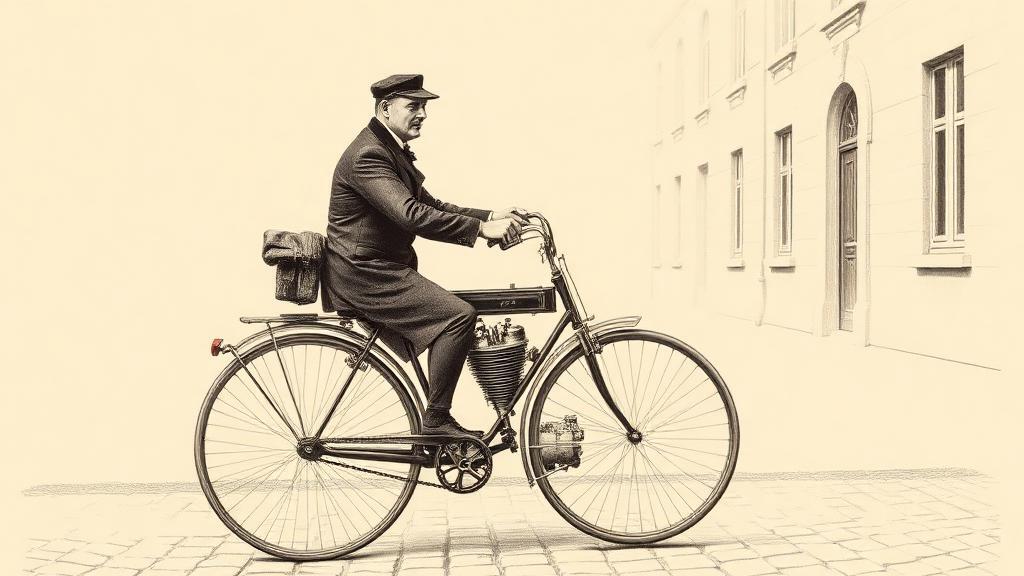
Hildebrand & Wolfmüller: the first motorcycle you could buy
The prescribed method for starting a Hildebrand & Wolfmüller was to push it down the road until the engine caught, then jump on.
There was no kickstart — that technology was still years away — and no clutch, which meant stopping and re-starting required either a helpful bystander or a long enough slope. The rider controlled speed with a thumb-operated screw throttle. The brakes were a block of wood pressed against the front tyre. And yet in 1894, Heinrich and Wilhelm Hildebrand and Alois Wolfmüller put this machine on the market in Munich and sold somewhere between one and two thousand of them — the first motorcycle produced and sold to the public in series.
The Hildebrand brothers were steam engineers who had been building portable steam engines before the internal combustion age made their work obsolete. They pivoted, partnered with machinist Alois Wolfmüller and mechanic Hans Geisenhof, and filed German patent No. 78553 on 20 January 1894. By 1 March the first examples were coming out of their Munich factory.
The engine was a 1,489 cc water-cooled two-cylinder four-stroke, producing 2.5 horsepower at 240 rpm — enough to reach about 45 kilometres per hour on a flat road. What made it mechanically strange was the drivetrain. The cylinders sat horizontally in the frame, and their connecting rods ran directly back to pins on the rear axle: no transmission, no chain, no intermediate gears. The rear wheel was the crankshaft. The Hildebrands were steam engineers, and they designed accordingly.
The consequence was that the rear wheel had to serve as a flywheel as well — and an 1894 bicycle rim is a poor flywheel. To compensate, the designers attached heavy rubber bands from the connecting rods to the rear axle, which snapped the pistons back on the return stroke. Those bands aged badly; contemporary riders reported they stretched and failed within months. It was one of several reasons production wound down by 1897.
The rear mudguard doubled as the radiator: a hollow metal shell filled with water, which the engine boiled off as it ran. On a warm day, a long ride meant periodic stops to refill. The patent introduced a name for the vehicle that solved a different problem — what to call the thing. Motorrad: motor-wheel. It was the first appearance of the word in a legal document, and it remains the German word for motorcycle today.
What the Hildebrand & Wolfmüller established was the idea that a motorised two-wheeler was a product, not a prototype — something a civilian could order, pay for, and ride to work. The machine found buyers in France as well as Germany, and roughly two thousand were built before better-funded competitors with cleaner engineering overtook it. The Hildebrand & Wolfmüller didn’t survive the 1890s. The category it created did.
Several survive in museums: at the Barber Vintage Motorsports Museum in Birmingham, Alabama, the Science Museum in London, and the Deutsches Zweirad- und NSU-Museum in Neckarsulm. Each one is, in a precise sense, the ancestor of every motorcycle that followed — including the ones with electric starters, and clutches, and crankshafts that don’t need rubber bands to turn.
Sources
- Hildebrand & Wolfmüller — Wikipedia — patent date and number, technical specifications, production volume, rubber-band return system, French licensing.
- 1894 Hildebrand & Wolfmüller — Barber Vintage Motorsports Museum — engine operation, starting procedure, technical details, and surviving specimen.