cryptography · 3 min read
Jefferson's wheel cipher, or the invention the army made twice
In 1922, a historian named Edmund C. Burnett was working through Thomas Jefferson’s papers at the Library of Congress — sorting Continental Congress records for a book that had nothing to do with ciphers — when he came across a manuscript describing a mechanical encryption device. He would have recognised it at once. The United States Army had officially adopted it that same year.
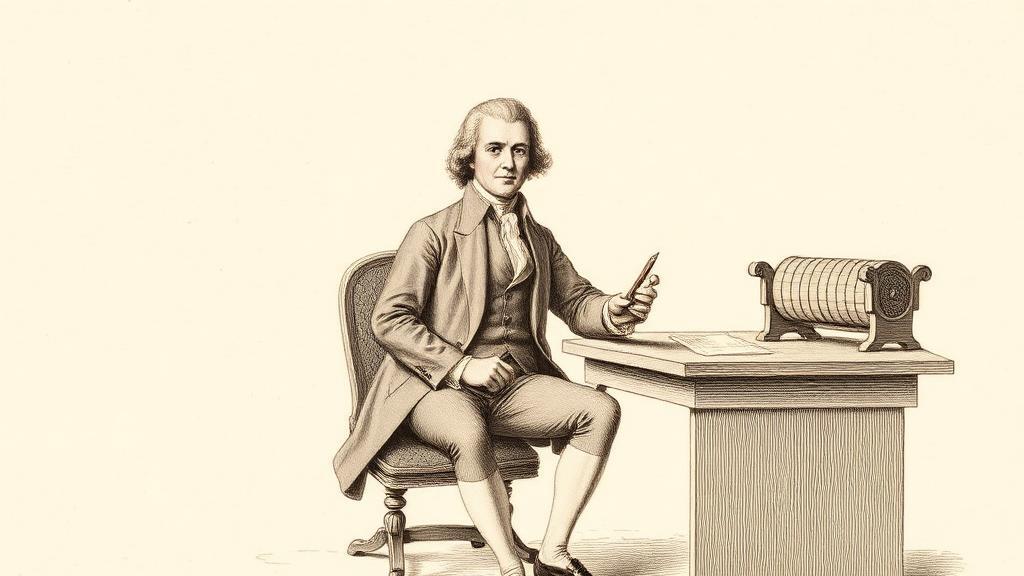
The device Jefferson had described, sometime in the early 1790s while serving as George Washington’s Secretary of State, was a stack of thirty-six wooden disks threaded onto an iron spindle. Each disk bore the twenty-six letters of the alphabet in a different scrambled order around its edge; the sequence of disks was the key. Both sender and receiver held identical sets arranged in the same agreed-upon order.
To encrypt, the sender rotated disks until the plaintext appeared along one row, then copied down any other row — an apparently meaningless string — and sent it openly. The recipient reversed the process: align the ciphertext, find the single row that resolved into plain language. An attacker who captured the message still faced all 36! possible disk orderings — a number with 41 digits. It required no pen-and-paper table, no look-up book, no clerk with a keyword: only a spindle and the knowledge of which row to read.
Jefferson apparently never built it. He set the manuscript aside, and in 1803, when his friend Robert Patterson suggested a different cipher — a columnar transposition — Jefferson thought it practical enough to give to Meriwether Lewis for the expedition west. Lewis never used it either, which may say something about how much the Corps of Discovery feared diplomatic interception on the Missouri River. The wheel cipher sat in Jefferson’s papers, unbuilt and untested, for the next 127 years.
Meanwhile, the same concept was independently arriving at the same conclusion. In 1891, French Commandant Étienne Bazeries built a version with twenty disks, having worked the principle out from scratch. Colonel Parker Hitt and Major Joseph Mauborgne of the U.S. Army Signal Corps then built from Bazeries’s design; by 1917 they had a prototype, and in 1922 the Army formally adopted the M-94: twenty-five aluminum disks on a four-and-a-half-inch rod. Jefferson, Bazeries, the Signal Corps — three independent minds, one device.
The M-94 served the Army, Navy, State Department, and various civilian agencies through the 1930s, without its designers apparently knowing that the third president had sketched the same idea more than a century earlier. It fell out of use by 1942. German and Japanese cryptanalysts had developed crib-alignment attacks: if you knew a probable word in the plaintext, you could test it against each ciphertext row and check whether the remaining disks resolved consistently. By early 1943, American officials had confirmed the system had been broken by multiple Axis services.
What the wheel cipher left behind was a generative idea: that a cipher machine could be a rotating wheel, shifting alphabets automatically with each character. Jefferson had it in the 1790s and set it aside. When Enigma’s rotors turned, half a century later, they were running the same logic — and nobody in Bletchley Park knew the third president had been there first.
Sources
- Jefferson disk — Wikipedia — design details, 1922 discovery of manuscript by Burnett, Bazeries reinvention, M-94 lineage.
- Wheel Cipher — Monticello — Jefferson’s original manuscript and abandonment in 1803 after Patterson’s suggestion.
- M-94 cipher machine — Wikipedia — specifications, Hitt and Mauborgne, service history, cryptanalytic vulnerabilities.
- Jefferson-Lewis Cryptology — Discover Lewis & Clark — Jefferson’s keyword cipher for the expedition, Lewis’s non-use.