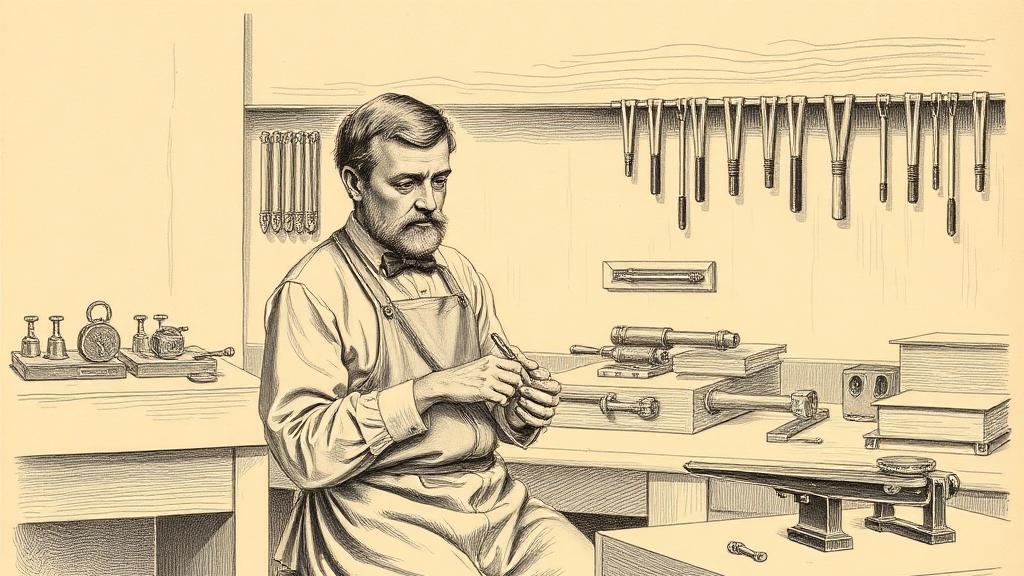
Yale's cylinder lock, or how the portrait painter solved the front door
The key in your front door — small, flat, serrated along one edge with a profile that looks like a tiny metal skyline — was designed in 1865 by a man who had spent his twenties apprenticed to a portrait painter.
Linus Yale Jr. was born in Salisbury, New York, on 4 April 1821, the son of Linus Yale Sr., a lock manufacturer who had opened a shop in Newport, New York, in the 1840s specializing in bank vault mechanisms. The son showed every sign of the same mechanical aptitude but chose a different career: he studied portraiture through the late 1840s, intending something in oils and canvas. His father’s death around 1850 closed that chapter. Yale entered the family business, opened his own workshop in Shelburne Falls, Massachusetts, around 1860, and turned his attention toward a problem the trade had not cleanly solved: how to make a lock small enough for an ordinary door yet precise enough to resist a determined pick.
His answer was the cylinder pin-tumbler. Yale filed an early version as U.S. Patent 31,278 in 1861 — nominally for a “post-office door lock, drawers, closets, cupboards, &c.” — but the design that became universal arrived with Patent 48,475 in 1865: a short brass plug seated inside a fixed casing, with a row of spring-loaded pins of varying lengths blocking the plug from turning. The correct key, flat and serrated along its upper edge, pushed each pin to its precise depth; all the pins aligned at the shear line between plug and casing simultaneously, the plug rotated, the latch withdrew. The wrong key left even one pin misaligned and nothing moved.
The principle was not new. Egyptian craftsmen had built wooden pin tumblers in palm-wood bolts since roughly 4000 BCE — the earliest known lock in any form. What Yale’s version offered was precision manufacturing: identical cylinders, identical pins, keys cut from a blank on a machine rather than filed by hand. A locksmith could rekey a cylinder by swapping pins rather than replacing the whole mechanism. That combination of standardization and repairability is what made the design propagate everywhere.
Yale had a confrontational streak that served him well commercially. He publicly demonstrated picking competitors’ best cylinders — including lock designs that had embarrassed the British establishment at the Great Exhibition of 1851 — and stood behind his own bank vault mechanism with a $3,000 open challenge to anyone who could defeat it. No one collected.
In October 1868, he partnered with Henry Robinson Towne to found the Yale Lock Manufacturing Company in Stamford, Connecticut, with 35 employees and a full order book. He died on Christmas Day 1868, aged 47, still in contract negotiations for a Manhattan skyscraper’s lock installation. He saw none of what followed: by the early twentieth century, roughly three-quarters of American banks had Yale locks on their vaults; by the late twentieth, the cylinder pin-tumbler was simply the default assumption of every residential door in the developed world.
The wooden pin tumblers of ancient Egypt and the brass cylinders of Shelburne Falls obey the same logic: push each pin to its depth and the plug turns. Six thousand years of work on that one problem, and nobody has come up with a better answer.
Sources
- Linus Yale Jr. — Wikipedia — Life dates, portrait-painting career, patents timeline, Yale Lock Manufacturing Company founding with Towne.
- Linus Yale Jr. — ASME — The $3,000 challenge, death during skyscraper negotiations, company growth to 12,000 employees.
- U.S. Patent 31,278 — Google Patents — Original 1861 cylinder lock patent for post-office and domestic locks; transitional step to the 1865 design.
- Pin Tumbler Lock — Wikipedia — Egyptian origins c. 4000 BCE, mechanism description, Yale’s 1865 refinement and universal adoption.