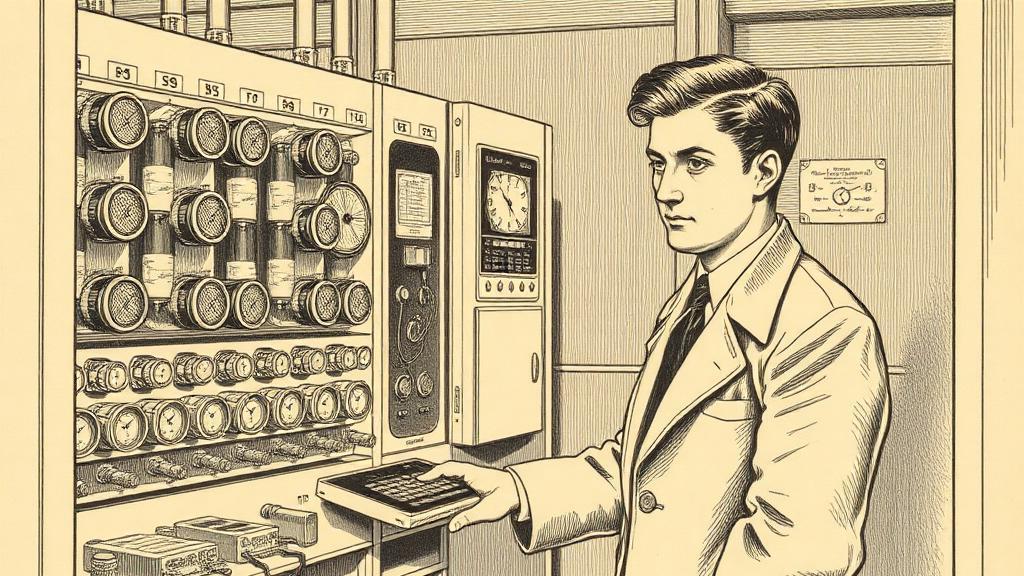
The Manchester Baby and the first stored program
At 11 a.m. on 21 June 1948, a room-sized rack of vacuum tubes and cathode-ray screens at the Victoria University of Manchester started running a program — not because someone had hand-wired the instructions in, not because a paper tape was threading through a reader, but because the instructions themselves were stored inside the machine’s own memory. Seventeen lines of code, held electronically. The Baby had something to remember.
That machine — the Small-Scale Experimental Machine, nicknamed “the Baby” — was built by Frederic “Freddie” Williams, Tom Kilburn, and Geoff Tootill at Manchester. Williams and Kilburn had met during wartime radar research and come to the university to turn a clever trick with cathode-ray tubes into something genuinely useful. A CRT, they found, could hold a pattern of charged dots on its phosphor screen long enough to read them back before they faded — refresh the dots fast enough, and you had a working memory. They called it the Williams-Kilburn tube.
The Baby was a testbed for that tube. It measured 17 feet by 7.4 feet, weighed roughly a ton, and was assembled from 300 thermionic valves and 250 other components, most of them war-surplus, including Bletchley Park salvage. Against the 95-foot, 27-ton ENIAC across the Atlantic, it was indeed a baby.
Kilburn’s first program asked a specific question: what is the highest proper factor of 2¹⁸, or 262,144? The machine tested every integer from 262,143 downward, checking each for divisibility until it found one that worked. It took 3.5 million operations and 52 minutes to arrive at 131,072. Not fast. But correct, and — crucially — run from its own memory without a human in the loop.
Professor David Edwards, then a young physics graduate on the project, remembered the uncertainty right up to first run: “There was considerable uncertainty in the beginning, about whether or not it would succeed. And when we started off every single component had to be connected together — and the pieces were very, very large” (University of Manchester). The gap between a diagram on paper and a machine that actually worked was closed, as it usually is, by patience and a soldering iron.
The stored-program idea — that instructions and data could live together in the same addressable memory, and that the machine itself could modify its program mid-run — had been sketched by von Neumann and others in papers circulating since 1945. The Baby made it physical. Within a year, Williams and Kilburn had expanded it into the Manchester Mark 1; within three years, Ferranti had licensed the design and produced the Ferranti Mark 1, the world’s first commercially sold computer.
Every program since — every compiler, every operating system, every app on every phone — runs on the premise the Baby proved at 11 a.m. in Manchester: that a machine can carry its own instructions. The instructions got faster. They got smaller. They got incomprehensibly numerous. But they are still stored in memory, right where Kilburn left them.
Sources
- Manchester Baby — Science and Industry Museum — builders, timeline, first program details, size and component count, Bletchley Park surplus, Ferranti connection.
- How a 70-year-old ‘Baby’ changed computing — University of Manchester — David Edwards’ first-hand recollection of the uncertainty and hand-wiring.
- The Stored Program — Computer History Museum — stored-program concept, Williams-Kilburn tube as first electronic RAM, Manchester Mark 1 and Ferranti Mark 1.