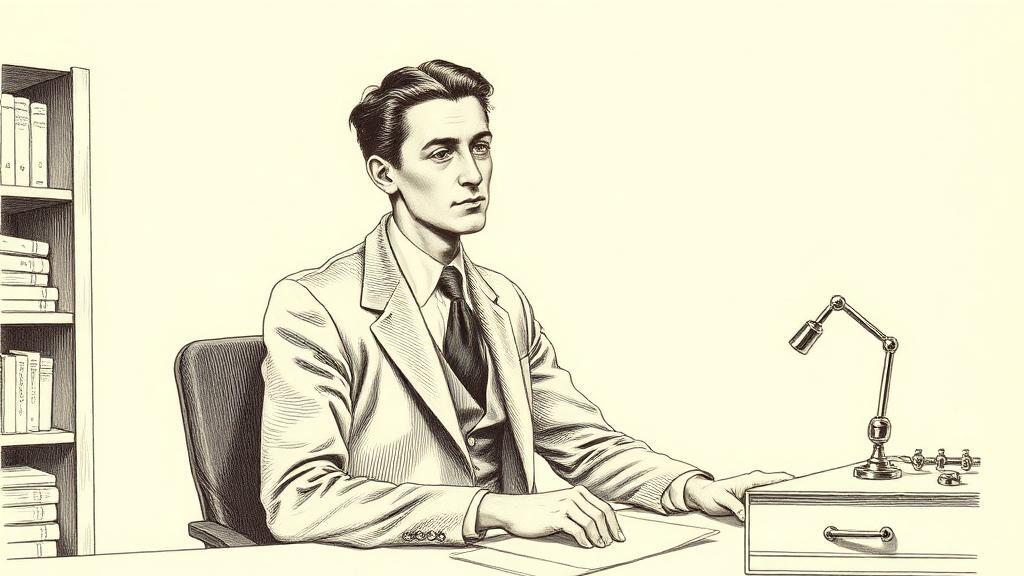
Shannon's 1949 paper, and the price of a perfect cipher
In the Bell Labs cafeteria on West Street in Manhattan, early in 1943, two men ate lunch together nearly every day for weeks. One had just come from Bletchley Park, where he had broken the German navy’s Enigma cipher. The other was building SIGSALY, the scrambled voice link connecting Churchill to Roosevelt. They talked about chess, thinking machines, and the human brain. They did not exchange, as Shannon would later recall, a single word about cryptography.
Claude Elwood Shannon, twenty-seven years old in 1943, was a research mathematician at Bell Telephone Laboratories in New York. On September 1, 1945, two years after those lunches, he filed a classified memorandum — MM 45-110-02 — titled “A Mathematical Theory of Cryptography.” The report sat in a drawer for four years, visible only to those with clearance. Then, in October 1949, the Bell System Technical Journal published a revised version under the title “Communication Theory of Secrecy Systems”. It ran to sixty pages and changed every assumption the field had made about what security meant.
Before Shannon, cryptography was an empirical trade: ciphers were designed by intuition, broken by ingenuity, and replaced by something marginally harder. Shannon gave it mathematics. He defined, with precision, what it means for a cipher to be secure. A system achieves perfect secrecy, he proved, if an adversary who intercepts the ciphertext learns nothing about the plaintext — not even a probabilistic lean, not even a narrowing of possibilities, regardless of how much computing power they apply.
Then came the proof no one wanted: the only way to achieve perfect secrecy is if the key is at least as long as the message, drawn from a genuinely random source, and never reused. The one-time pad — sketched by Frank Miller in 1882, reinvented by Gilbert Vernam in 1917 — was the sole perfectly secure cipher. Every other system fell short by mathematical definition. Shannon had not described the field; he had fenced it.
For the practical world where a key the length of the message is an absurdity, Shannon introduced two design principles: confusion (obscuring the relationship between key and ciphertext) and diffusion (spreading each bit of plaintext across as much of the ciphertext as possible). Every serious symmetric cipher built since — DES, AES, and their descendants — was designed on these two ideas.
The man eating lunch with Shannon in 1943 had independently arrived at nearly the same territory. Alan Turing had developed his own entropy measure — he called the unit a “ban” — around 1940, to quantify how much information each intercepted German message carried. Shannon later said Turing gave him “negative feedback” on his information theory ideas. Neither man knew how close the other had come. Turing was bound by the Official Secrets Act. Both men left the cafeteria each day carrying half the answer.
Shannon’s paper set the terms under which every subsequent advance would be defined. It explained why the Soviets’ decision to reuse one-time pad keys was not merely a procedural lapse but a mathematical catastrophe. It mapped the intellectual ground that Diffie, Hellman, Rivest, Shamir, and Adleman would later inhabit.
Perfect secrecy is achievable. Shannon proved it — and proved it costs a key as long as your message, drawn from true randomness, used exactly once. Every cipher built since has been a negotiation with that constraint.
Sources
- Communication Theory of Secrecy Systems — Bell System Technical Journal (Wiley) — Shannon’s original 1949 paper; source for perfect secrecy definition, one-time pad proof, confusion and diffusion.
- Communication Theory of Secrecy Systems — Wikipedia — overview of the paper’s contents, historical significance, and the 1945 classified memo.
- The Ban and the Bit: Turing, Shannon, and Entropy — Shannon’s own recollection of the Bell Labs cafeteria meetings and what they did, and did not, discuss.