Michelin's flytrap: the tyre the industry couldn't copy
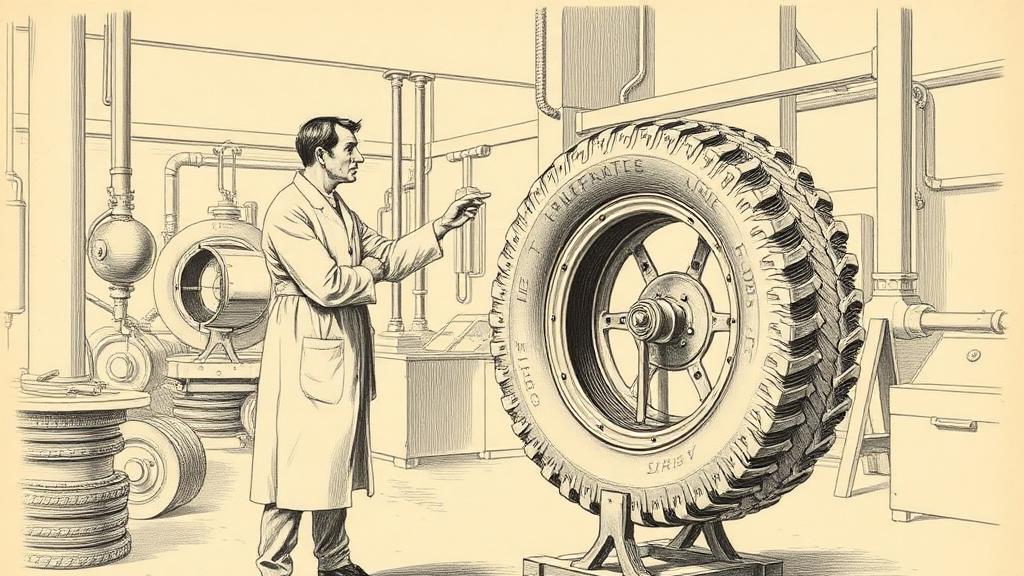
The engineers at Michelin’s Clermont-Ferrand facility had a private name for their prototype tyre in the mid-1940s: the cage à mouche — the flytrap. It did not look like a promising commercial brand. It turned out not to matter.
The problem Marius Mignol had spent years trying to solve was simple enough to state: bias-ply tyres overheated. In the standard design of the day, reinforcing cords ran diagonally across the carcass at 35 to 45 degrees, alternating in opposing directions in successive layers. Every time the tyre flexed under load — which, on a moving car, is continuous — those opposing plies scraped against each other, generating friction, building heat. Heat degraded the rubber. The sidewall was cooking itself from the inside.
Mignol’s response was to split the tyre’s two functions apart. A tyre needs a sidewall that can flex — it is what absorbs road irregularities and keeps the contact patch on the ground. It also needs a tread that stays rigid and stable, to maintain grip through corners and braking. In a bias-ply tyre, a single cord structure was asked to do both, and it failed at both under stress. Mignol arranged the carcass cords to run radially — perpendicular to the direction of travel, parallel to the wheel’s radius — then added a separate steel belt beneath the tread to stabilise it. Sidewall and tread were decoupled. Each could now do its job without fighting the other.
Michelin’s Technical Director Pierre-Marcel Bourdon registered the patent in Paris on June 4, 1946, under reference FR 942,086. The Michelin X went on commercial sale in 1948. The following year it appeared as optional fitment on the Peugeot, the Citroën 11, and the Simca 8. In 1951, Lancia fitted it as standard to the Aurelia B20 — the first production car to leave the factory on radials.
The results were difficult to argue with. The Michelin X lasted roughly twice as long as an equivalent bias-ply tyre. Rolling resistance fell, reducing fuel consumption on every journey. Wet-weather grip improved substantially. The heat problem that had been degrading sidewalls since the beginning of the pneumatic tyre disappeared almost entirely. Michelin was confident enough in the technology that it stopped manufacturing bias-ply tyres altogether in 1956.
What Michelin had also secured was a fifteen-year lock on the relevant patents. Competitors spent those years engineering workarounds — rayon, nylon, and polyester belts in place of the steel belt Michelin had tied up — and none achieved quite the same combination of ride, grip, and wear life. When the patents began to expire in the early 1960s, the resulting adoption was rapid: by the early 1970s, 80 to 90 percent of new European cars came from the factory on radials.
The Citroën DS, shown at the 1955 Paris Motor Show with its hydropneumatic suspension, gave a preview of what radial tyres and a properly engineered chassis could produce together. The car floated over road surfaces that would have shaken a conventional vehicle apart. Reviewers reached instinctively for the word “magic.” The tyre was half of that.
Every production car today runs on a descendent of the cage à mouche. The carcass cords are now polyester or aramid fibre, the steel belts are finer, and the compound chemistry is unrecognisable — but the governing idea, the separation of sidewall and tread, the radial carcass held firm by a steel belt, is exactly what Mignol’s engineers worked out in Clermont-Ferrand. The name, at least, they improved on.
Sources
- The triumph of the radial tyre — Michelin UK — patent date and registration, Pierre-Marcel Bourdon, development history, Michelin’s discontinuation of bias-ply production in 1956.
- Michelin and the Birth of the Radial Tyre — Auto Universum — Marius Mignol, the cage à mouche internal name, early fitment on Peugeot/Citroën 11/Simca 8, Lancia Aurelia B20 as first standard-fit radial car.
- Michelin Radial Technology — Michelin Middle East B2B — technical details of radial construction, steel belt function, rolling resistance and fuel economy improvements, European market adoption figures.