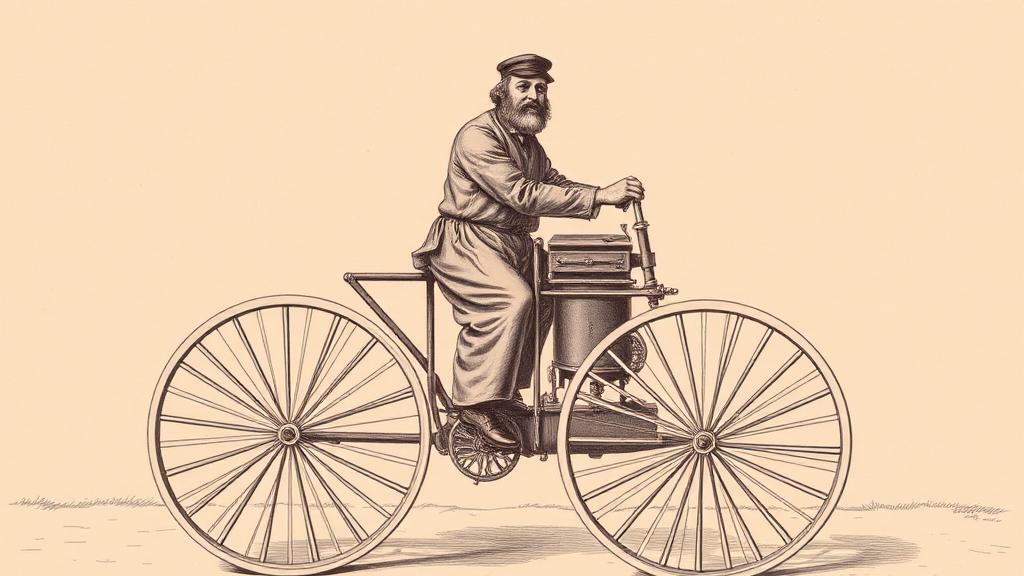
Sylvester Roper's steam velocipede
On 1 June 1896, a 73-year-old machinist named Sylvester H. Roper arrived at the Charles River Speedway in Cambridge, Massachusetts, climbed aboard a machine he had been refining since the 1860s, and proceeded to humiliate the fastest bicycle racers in Boston. ‘The trained racing men could not keep up with him,’ the Boston Globe reported the next day. Roper clocked a flying mile in two minutes and one and two-fifths seconds. Then his front wheel wobbled, and he fell. His son Charles reached him at trackside and found him dead of a massive heart attack.
The machine Roper fell from was a steam-powered velocipede — broadly, the world’s first motorcycle. He had built the first version of it nearly thirty years earlier, in his workshop in Roxbury, then still its own city a mile or two south of Boston. Roper was born in 1823 in Francestown, New Hampshire, a village of a few hundred people in the Merrimack hills, and had trained himself into one of the more prolific machine inventors of his generation: patents on sewing machines, furnaces, fire escapes, repeating shotguns. He had the habit of solving problems he found interesting regardless of whether anyone had asked.
Around 1867 he set a two-cylinder steam engine into the frame of a bone-shaker bicycle — the iron-wheeled contraptions that had just arrived from France and were rattling spines from New York to Boston. The engine displaced 164 cubic centimetres per cylinder, 328 cc in total. The boiler burned charcoal; the water sat inside the saddle, which Roper had hollowed and sealed into a tank. The handlebars served double duty: rotate them forward and you opened the throttle; rotate them backward and a steel spoon pressed against the front wheel. That gesture — twist forward for speed, twist back for less — is the same one that operates every motorcycle throttle built since.
The peculiar detail is what Roper did not do: file a patent. He held patents on practically everything else he touched. The steam velocipede, the most consequential thing he ever built, appears in no patent record. He seems to have simply kept riding it instead, making regular seven-mile trips from his Roxbury home to the Boston Yacht Club — which may constitute the first motorcycle commute in history. In 1894 he accepted a commission from bicycle manufacturer Albert Augustus Pope to build a second version: a Pope Columbia safety-bicycle frame, Dunlop pneumatic tires, a smaller single-cylinder engine operating at steam pressures up to 225 psi. That was the machine he was riding when it killed him.
An 1869 example of the original velocipede is now at the National Museum of American History in Washington — the oldest surviving American motorcycle. Its claim to historical priority over the Michaux-Perreaux steam velocipede, built in France at roughly the same time, has never been definitively resolved: the French machine had a patent, number FR 83,691, filed 1869; Roper’s did not.
The motorcycle industry that followed would run on gasoline, not steam. Gottlieb Daimler and Wilhelm Maybach filed a patent for a petroleum-fuelled two-wheeler in Bad Cannstatt eighteen years later. But Roper had already answered the essential question: that two wheels and a small engine were enough, and that anyone given both would want to go faster. He was 73 and still going faster than professional cyclists when that wanting finally caught up with him.
The throttle geometry he worked out in Roxbury in the 1860s was never improved upon. It was only made smaller.
Sources
- Roper Steam Velocipede — Wikipedia — dates, technical specifications, historical context, and priority debate with Michaux-Perreaux.
- Sylvester Roper’s Steam Velocipedes — The Vintagent — detailed technical analysis, Boston Globe quote from the 1896 race, the no-patent detail, and the commuting record.
- Roper Steam Velocipede, about 1869 — Smithsonian Institution — collection notes for the 1869 example on permanent display at the National Museum of American History.