sports · 3 min read
Football's first rulebook: Rugby School, August 1845
The first law of football ever published reads without ceremony: “A fair catch is a catch direct from the foot.” No preamble, no statement of purpose — just a definition, followed by thirty-six more. The three students tasked with writing them had given themselves three days.
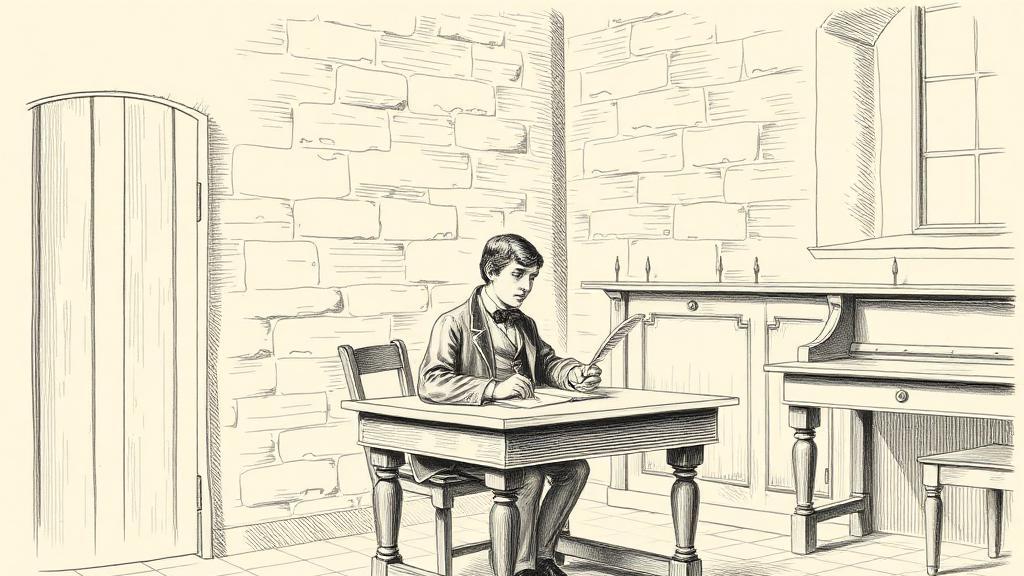
The scene was Rugby School in Warwickshire, August 25, 1845. The head schoolboy and football captain, Isaac Gregory Smith, assigned the job to William Delafield Arnold, seventeen, Walter Waddington Shirley, sixteen, and Frederick Hutchins. By August 28 they had submitted their thirty-seven rules to the Sixth Levee — the school’s senior prefectorial body — which passed them without amendment. A rulebook was printed. No football game in history had previously possessed a written constitution.
William Arnold was not a random pick. His father was Thomas Arnold, the headmaster who had turned Rugby School from a middling provincial institution into the template for every English public school that came after. Thomas Arnold had died in June 1842, three years earlier, on the school grounds, the morning after his forty-seventh birthday. His son stayed on as a pupil and, in the August of 1845, quietly codified the most popular game on the premises.
The thirty-seven rules are a remarkable document. Rule VIII permits running with the ball “provided he does not take the ball off the ground, or take it through touch.” Rules XXVI and XXVII govern hacking — kicking opponents in the shins was explicitly legal, within limits: nothing heel-first, nothing above the knee, and in open play only the first defender could be targeted (in a scrummage, everyone was fair game). Rule XXVIII, a small masterpiece of practical jurisprudence, bans “projecting nails or iron plates on heels or soles.” Someone had evidently learned this before the rule was written.
Then there is Rule XX: a match ends after three days if no goals have been kicked, or five days otherwise. Five days. The Victorian public schoolboy had, apparently, extraordinary stamina and an empty schedule.
By the mid-19th century the question of what football was had become genuinely confused. Different schools played different variants, the rules unspoken and renegotiated after every dispute. The 1845 Rugby School laws were the first attempt anywhere to settle the matter in writing: this is the game, here are its terms, here is a printed book. The Cambridge Rules followed in 1848, the Sheffield Rules in 1858, the Football Association’s Laws of the Game in 1863. Every codification that followed either borrowed from Rugby School’s framework or defined itself in explicit opposition to it.
The famous story about William Webb Ellis — the pupil who allegedly picked up the ball and ran with it in 1823, inventing rugby on the spot — has an inconvenient problem: in 1823 there were no written rules to break. The story first surfaced in 1876, more than fifty years after the supposed event, in a letter to a local antiquarian. The Old Rugbeian Society’s investigation in 1895 found it unverifiable. It is a tidy myth. The 1845 rulebook is a better fact.
William Arnold left Rugby, went to Oxford, sailed to India as the first Director of Public Instruction in the Punjab. He died at thirty-one in Gibraltar, in April 1859, on the passage home from Calcutta. His brother Matthew Arnold — the poet — wrote “A Southern Night” in his memory. The thirty-seven rules William drafted at seventeen went on without him.
Sources
- Laws of Football as played at Rugby School (1845) — Wikisource — primary text of all 37 rules, including the fair-catch definition, hacking regulations, and the five-day match provision.
- 1840s — Rugby Football History — detailed account of the August 1845 drafting process, the three authors, and the Sixth Levee approval.
- History of rugby union — Wikipedia — context on the Webb Ellis legend, its investigation and debunking, and the 1845 rules’ place in football codification history.