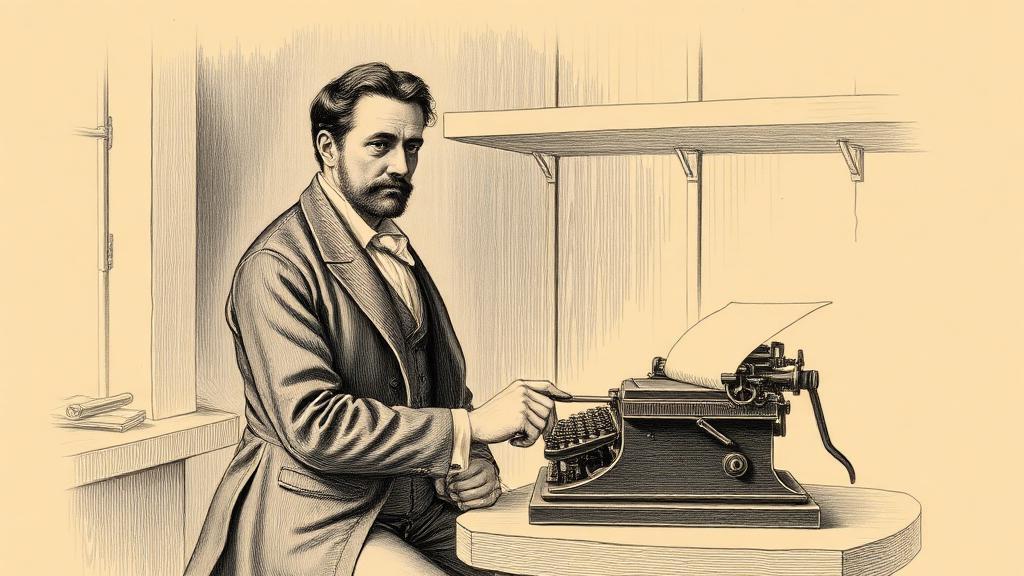
Sholes's typewriter: the machine that froze the alphabet
The first typewriter that Remington put on sale in 1874 could only type in capitals. At $125 — close to a month’s wages for a skilled worker — it also typed slowly enough that a practiced penman could probably keep pace. The machine’s inventor, Christopher Latham Sholes, had already sold it and moved on to other things. What nobody expected was that the particular arrangement of keys on that one machine would still be on every laptop and every phone in the world a hundred and fifty years later.
Sholes was a Milwaukee newspaper editor and printer when he started the project in 1866. His friend Carlos Glidden noticed that a coupon-numbering machine Sholes had built could, with some modification, print letters instead of digits. Sholes recruited a Milwaukee printer named Samuel Soulé and the three of them filed a patent application in October 1867; the patent was granted on June 23, 1868. Through roughly thirty prototype iterations, the mechanism took shape: a bank of key levers, each attached to a hinged type bar that swung up to strike an inked ribbon against paper. It worked. It also jammed, frequently and badly.
The original layout was roughly alphabetical. When a typist struck two adjacent keys in quick succession, the type bars would collide in mid-swing and lock together in a metallic tangle. Sholes’s solution was to separate the most commonly paired letters in English, scattering frequent combinations like TH and SH to opposite ends of the keyboard. The result, read across the top row, spelled Q-W-E-R-T-Y. A competing theory — argued by Kyoto University researchers Koichi and Motoko Yasuoka — holds that the layout was shaped as much by telegraph operators as by mechanical necessity. Sholes’s first sale was to Porter’s Telegraph College in Chicago in 1868, and operators needed S and Z, near-identical in Morse code, kept close together. The keyboard accommodates both explanations.
Sholes sold his production rights to Remington in 1873. Remington’s gunsmiths turned their precision metalwork to the new machine, and the Sholes & Glidden Type Writer launched in 1874. QWERTY took its final form on the Remington No. 2, in 1878. In 1893 the major typewriter manufacturers merged into the Union Typewriter Company and standardized the layout industrywide. There was no longer any debate.
Here is the irony the story usually buries. In 1889 — fifteen years after Remington had embedded QWERTY into the hands of every office typist in America — Sholes filed a patent for an entirely different keyboard arrangement, one he called the XPMCH layout. The man who gave the world its most durable interface was still trying to escape it. The application went nowhere. By then the layout owned the typists, not the other way around.
The deeper change the typewriter brought was social. Before the 1870s, business correspondence was handwritten, slow, and staffed almost entirely by men. By the 1890s, the typing pools were dominated by women — faster, more accurate, and cheaper to hire — and the typewriter had become the instrument through which millions of women entered professional life. It also fixed something more abstract: a shared physical interface between a human hand and written language, a grammar of keys that the electric typewriter, the PC keyboard, the touchscreen, and everything after would inherit wholesale.
QWERTY was a hack to stop metal bars from jamming. That it governs the thumbs of eight billion people is not a design triumph. It is what happens when the first solution works just well enough.
Sources
- Christopher Latham Sholes — Encyclopaedia Britannica — biography, patent date, partnership with Glidden and Soulé, sale to Remington.
- Origins of the QWERTY Keyboard — University of Wisconsin — telegraph-operator theory, keyboard iterations, the Porter’s Telegraph College sale.
- Where Did the QWERTY Keyboard Come From? — Smithsonian Magazine — commercial launch, XPMCH patent, lock-in dynamics.