The shoe that broke two hours
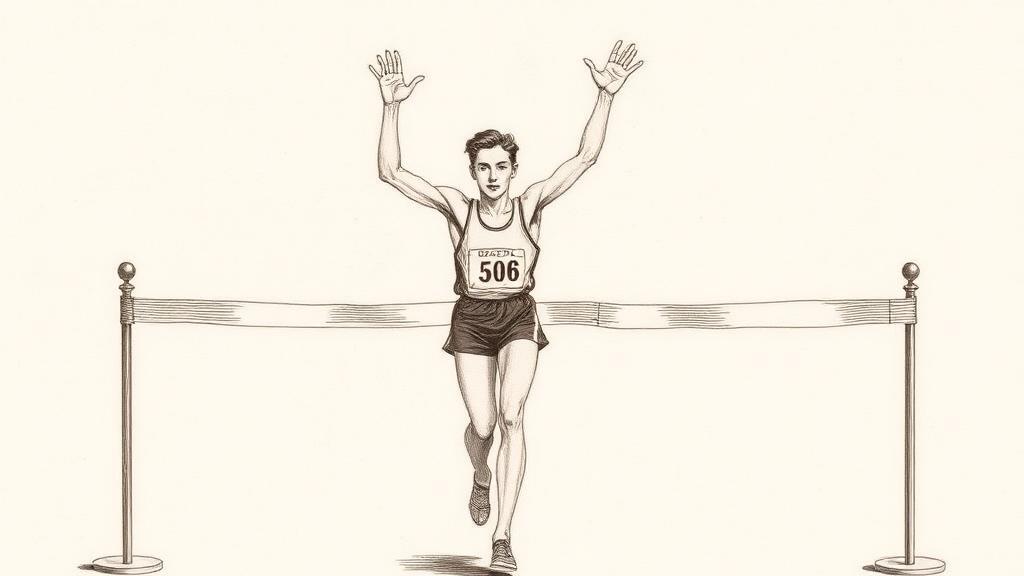
On the morning of April 26, 2026, Sabastian Sawe crossed the finish line on The Mall in London at 1:59:30. Eight hundred thousand people lined the streets. Sawe raised his hands. He had just run a competitive marathon — start gun, measured course, field of rivals, no pace car — in under two hours, under conditions that World Athletics would ratify as a world record.
The number 1:59:40 already existed. Eliud Kipchoge ran it on October 12, 2019, on the Prater Hauptallee in Vienna, surrounded by 41 rotating pacemakers and a laser-guided electric vehicle. World Athletics would not ratify it. Relay pacemakers violate the rules. A vehicle at close range violates the rules. Fuelling must follow standard race-day protocol. Kipchoge’s run was deliberate and extraordinary and an exhibition. What Sawe did was a race.
Sawe was born on March 16, 1995, in Barsombe, a village in Kenya’s Rift Valley Province. His father farmed maize; his grandmother, who largely raised him, kept a house with mud walls and no electricity. He made his marathon debut on December 1, 2024, at Valencia, winning in 2:02:05 — the second-fastest debut in history. He won London in April 2025. He won Berlin in September 2025. In seventeen months as a marathoner he ran sub-2:03 six times before he ran sub-2:00.
The shoe on his feet was the Adidas Adizero Adios Pro Evo 3. It weighed 97 grams — the mass of two hardboiled eggs. Its sole, 39 millimetres deep and one millimetre inside World Athletics’ legal ceiling, holds a U-shaped carbon-fibre frame that stiffens the edge of the shoe while Lightstrike Pro Evo foam compresses and rebounds at the centre — returning 11 percent more energy than the previous generation. The shoe costs $500 and Adidas built it for one race plus limited training use.
Before the gun, Sawe ate bread with honey and drank tea. He ran his first half in 60 minutes and 29 seconds; his second half took 59 minutes and one second — a negative split in a race where he got faster as it got harder. Yomif Kejelcha of Ethiopia crossed eleven seconds later at 1:59:41, also officially under two hours for the first time. Both wore the Evo 3. Adidas also equipped Tigst Assefa, who set a women-only world record at 2:15:41, improving her own previous mark. The company walked out of London with all the records worth carrying.
The gap between Sawe’s run and Kipchoge’s 2019 exhibition is more than administrative. Kipchoge’s 1:59:40 required seven months of planning, a bespoke course, 41 rotating pacemakers, a purpose-built vehicle, and conditions engineered so precisely they formed a physics problem as much as a race. Sawe’s 1:59:30 required a Sunday in April and a pair of shoes built to the rules. That is not a diminishment of either man — it is a measure of what the technology had done in seven years.
In 1954, forty-six days passed between Roger Bannister’s four-minute mile and the second one. On April 26, 2026, Yomif Kejelcha waited eleven seconds.
Sources
- 2026 London Marathon — Wikipedia — race results, world records set, spectator count, Assefa’s women-only world record.
- Sabastian Sawe — Wikipedia — biography, marathon career timeline, Valencia debut 2024, previous wins at London and Berlin 2025.
- Ineos 1:59 Challenge — Wikipedia — Kipchoge’s 2019 run and why World Athletics did not ratify it as a world record.
- The Adidas Super Shoe That Helped Runners Shatter Marathon Records — Dogo News — Adizero Adios Pro Evo 3 weight, carbon-fibre construction, energy return, retail price.