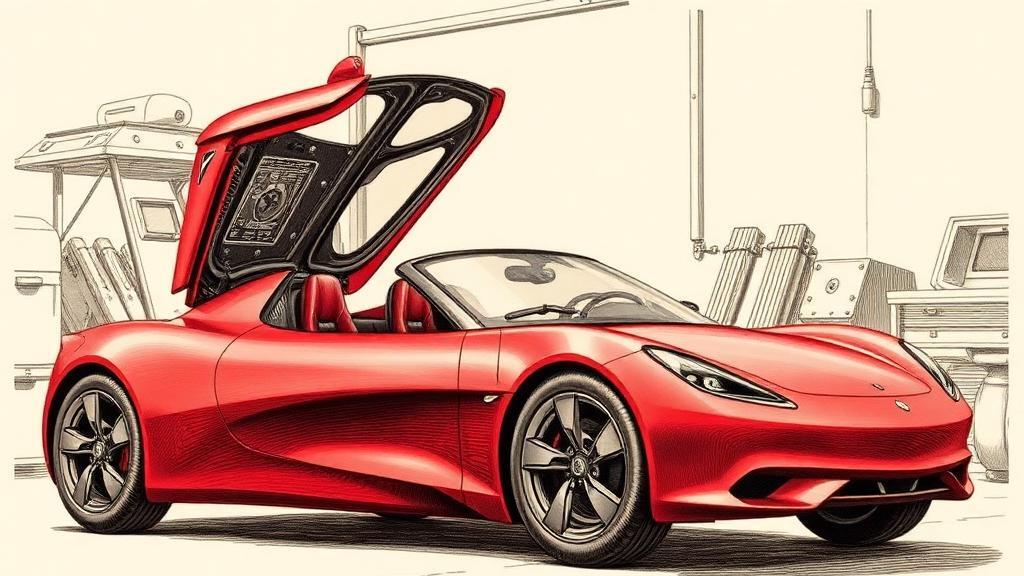
The Tesla Roadster, or how an electric sports car changed the conversation
In the winter of 2008, the first Tesla Roadsters to reach customers had their transmissions locked in second gear. This was not the plan. No supplier Tesla approached could build a gearbox capable of withstanding the instant, full-torque delivery of an electric motor — not at 248 horsepower, not at the RPM ranges involved. So the engineers did the only sensible thing: they shipped the cars anyway, with an IOU attached, and promised to fix it. The Roadster was never going to be a normal product launch.
Tesla Motors had been incorporated on July 1, 2003 by Martin Eberhard and Marc Tarpenning, two California engineers who had test-driven a prototype called the AC Propulsion tzero and come away convinced someone should build it for real (Wikipedia). When AC Propulsion declined to commercialize it, they did. Elon Musk joined as chairman and lead investor the following year, committing $7.5 million in seed capital after his own test drive. In 2005, Lotus agreed to supply modified chassis from its lightweight Elise sports car — and by the time the first Roadster left assembly, those shared components amounted to roughly 7 percent of the whole vehicle. The rest was Tesla.
The car that emerged was unlike anything the automotive world had certified before. At its heart sat a 53 kWh lithium-ion pack built from 6,831 laptop-grade cells — the same chemistry powering consumer electronics, scaled up and liquid-cooled into something capable of hurling a two-door sports car to 60 mph in 3.9 seconds and sustaining a 125 mph top speed. EPA range: 244 miles. Base price: $98,950. The National Highway Traffic Safety Administration granted a small-manufacturer airbag waiver in January 2008 — the same exemption it had given to Ferrari, Lotus, and Bugatti — and the first production car was delivered to Musk in February (Not a Tesla App). It was the first highway-legal, serially produced all-electric car to use lithium-ion cells, and the first to travel more than 200 miles on a charge.
The transmission problem, incidentally, was eventually solved. BorgWarner developed a single-speed reduction gear — simpler than a conventional gearbox and better suited to how electric motors deliver power — and Tesla retrofitted every early car at no charge. The customers who had been driving their locked-in-second-gear Roadsters in the meantime ran 0-60 in 5.7 seconds rather than 3.9. They did not complain very loudly.
On October 27, 2009, a Roadster covered 501 kilometers — 311 miles — on a single charge during the Global Green Challenge in outback Australia, setting a world distance record for a production electric car (Wikipedia). Tesla sold roughly 2,450 Roadsters across more than 30 countries before production ended in early 2012, when Lotus ceased supplying chassis.
What the Roadster actually proved was not just that batteries could replace a fuel tank. It proved that an electric car could generate desire — that someone would pay nearly a hundred thousand dollars not because they had to drive electric but because they wanted to. That shift — from sacrifice to aspiration — is what made everything afterward possible.
When the Model S arrived in June 2012, it carried a battery pack, a long-range claim, and an expectation the market had not held for any electric car before the Roadster. It also carried a price tag that, by then, seemed almost reasonable.
Sources
- Tesla Roadster (first generation) — Wikipedia — launch date, specs, production numbers, NHTSA waiver, transmission history, AC Propulsion origin, world distance record.
- Tesla’s Original Roadster: Price, Specs and Range — Not a Tesla App — pricing, battery specs, NHTSA certification, development context, Musk’s stated goals for the vehicle.