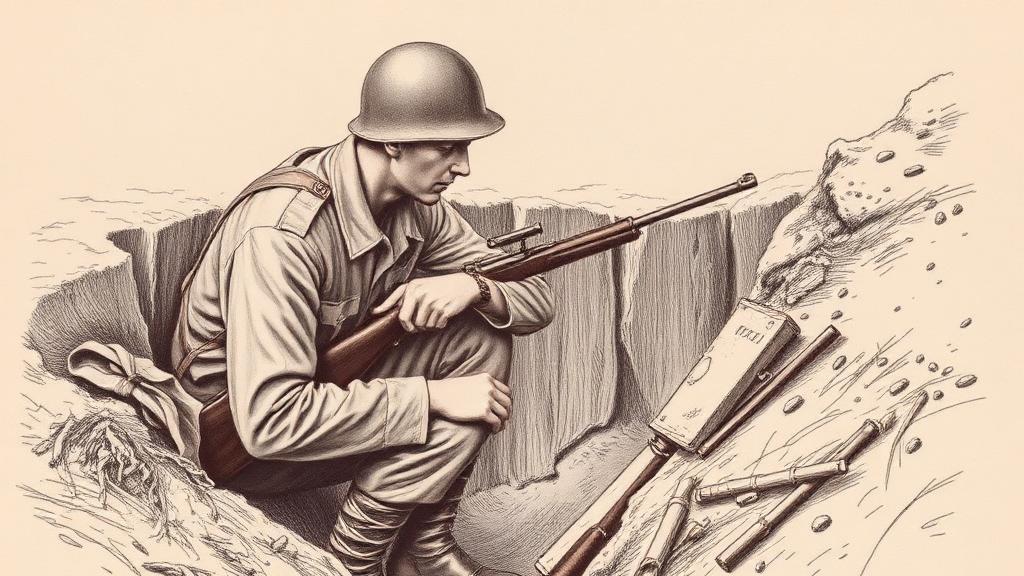
The wristwatch goes to war
Dawn, July 1, 1916. Somewhere along the British front in northern France, a staff officer checks his watch: it reads 7:29. In one minute, 120,000 men will go over the top behind a lifting artillery barrage. The gap between surviving and being killed by your own guns is measured in seconds. The officer does not reach for his coat pocket. He glances at his wrist.
The wristwatch had existed before the Somme, but only just, and mainly on women’s wrists. When Kaiser Wilhelm I ordered 2,000 wristwatches from Girard-Perregaux in 1880 for his naval officers, it was a practical novelty for men who needed both hands on a ship. On land, the gentleman reached into his waistcoat. The wristlet, as it was then called, was jewellery.
The Boer War nudged things slightly. By 1901, Mappin & Webb were advertising a Campaign watch — an Omega pocket-watch movement slipped into a leather wrist-strap, at an extra shilling — for British cavalry officers who needed both hands on the reins. Useful for a man on horseback; no one seriously imagined it as universal male kit.
The Western Front changed that with characteristic brutality. The trench watch that emerged from 1914 onward was a pocket watch’s interior transplanted into a new body: a sturdy case fitted with wire lugs for a leather strap, an enamel dial with wide white numerals readable in a single glance, a luminous radium hand that glowed in the dark of a dugout, and a metal grille across the crystal to stop shrapnel from turning a legible face into a blank. Omega and Longines produced them by the tens of thousands. A 1916 British military handbook listed the luminous wristwatch as the first item in an officer’s essential kit — ahead of the revolver, ahead of the field glasses.
The tactical reason was specific: the creeping artillery barrage. As guns shifted forward in timed increments, the infantry had to follow at precisely the right interval — close enough to advance under the barrage’s cover, not so close as to walk into it. Coordination to the second, across a front measured in kilometres, required that every officer carry a reliable watch where he could actually see it. By 1917, the British War Department had made wristwatches official issue. By mid-1916, roughly one-quarter of all soldiers in the field already wore one.
Here is the quiet social revolution buried inside the military one. For two decades, European and American men had declined the wristwatch precisely because women wore them. The trench watch was mechanically identical to what their sisters wore to garden parties — except that it had been through Passchendaele. When millions of Allied soldiers demobilized in 1918 and walked home still wearing their watches, the stigma evaporated. Watchmakers noticed. By the early 1920s, wristwatch output had overtaken pocket-watch output for the first time. The pocket watch had a few decades of dignified decline ahead of it, but it had already lost the war.
The wristwatch didn’t just survive the trenches. It absorbed them. Every clean-dialed field watch since carries the wire-lug bones of a design drafted, without ceremony, under artillery fire.
Sources
- Battle of the Somme — Wikipedia — July 1, 1916 zero hour and scale of the assault.
- Trench watch — Wikipedia — design features, the 1916 handbook detail, luminous radium hands, wire lugs, official British War Department issue 1917.
- The Trench Watch: A Brief History — Vintage Watch Specialist — Girard-Perregaux 1880 German Navy order, Boer War context, Mappin & Webb Campaign watch, Omega and Longines mass production.
- How the First World War Shaped the Watch Industry — Coronet — one-quarter adoption rate by 1916, creeping barrage synchronization detail, postwar cultural shift.