Konrad Zuse's Z3: the computer the war didn't notice
Sometime in 1935, Konrad Zuse quit his position at Henschel Aircraft, moved back into his parents’ apartment on Wrangelstraße 38 in Berlin’s Kreuzberg district, and began cutting metal parts by hand from aluminium sheet. He had decided to build a thinking machine. The living room was available.
The calculations that aeronautical engineers did by pencil were, as Zuse saw it, mechanical drudgery no human should have to repeat. He designed a floating-point binary calculator with programmable instructions, and for the next three years he and a handful of friends and family machined roughly 30,000 parts in the flat. The Z1, completed in 1938, was an extraordinary act of engineering ambition that almost completely failed to function: the hand-cut metal parts couldn’t hold the tolerances the machine required. Zuse moved to new premises on Methfesselstraße, acquired surplus telephone relays from a Berlin exchange, and started again. The Z2 ran in 1940. The Z3, on May 12, 1941, was ready.
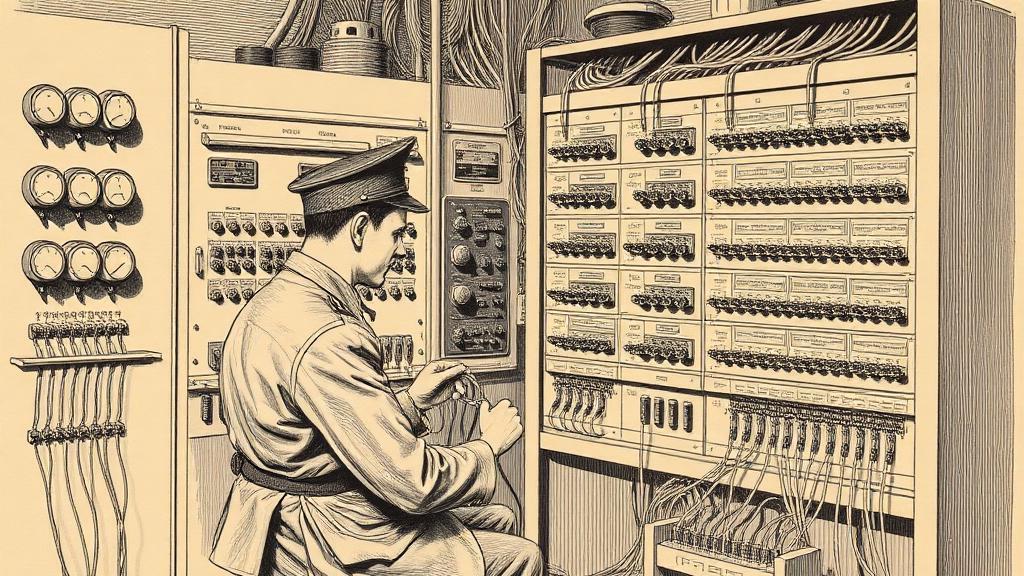
The Z3 used 2,600 telephone relays. It processed numbers as 22-bit binary floating-point values and ran at roughly 5 cycles per second — not megahertz, not kilohertz, just five relay clicks per second, steady as a pendulum clock, in the back room of a Berlin building. Programs were punched onto strips of discarded 35 mm film and fed in one instruction at a time. The machine could loop; it could compute a square root. It could not yet make a conditional jump — that remained an unsolved wiring problem — but within those limits, it was the world’s first working fully automatic programmable digital computer.
Zuse demonstrated the Z3 to scientists from the Deutsche Versuchsanstalt für Luftfahrt, the aeronautical research institute whose support had kept the project alive, and applied immediately to the Reich Air Ministry for additional funding — specifically to replace the telephone relays with vacuum tubes, which would run orders of magnitude faster. The Ministry reviewed the proposal and declined. The Z3, they concluded, was not war-important. The Z3 was, at that moment, being used to solve wing flutter equations for Luftwaffe aircraft.
When Zuse was briefly conscripted in 1941, he reportedly complained that while other men were leaving their families behind, he was leaving his computer. It was not an idle complaint. He had built the machine in near-total intellectual isolation, unaware of Alan Turing’s 1936 paper on computable numbers and Claude Shannon’s 1937 work on switching circuits. He had derived binary floating-point arithmetic and programmable instruction storage entirely on his own, in wartime Berlin. Alongside the Z3 he was drafting Plankalkül — what would become the first high-level programming language — though it would remain largely unpublished until 1972.
The original Z3 was destroyed on December 21, 1943, in an Allied bombing raid on Berlin: the same war that had ruled it unimportant. The Z4, its partially complete successor, was loaded onto a horse cart in February 1945 and moved through a series of farmhouses and Alpine cellars before arriving at ETH Zurich in 1950, where it became the first commercial computer in continental Europe.
The replica Zuse supervised in 1961 stands today at the Deutsches Museum in Munich, its 2,600 relays quiet behind glass. It looks like a telephone exchange, which it mostly is. The machines that followed it did not.
Sources
- Z3 (computer) — Wikipedia — technical specifications, May 12, 1941 demonstration, programs on punched film, destruction in 1943 bombing, and the Deutsches Museum replica.
- Konrad Zuse — Wikipedia — biographical details, Z1 in parents’ apartment, intellectual isolation from Turing and Shannon, the conscription anecdote, Plankalkül, and Z4’s evacuation to ETH Zurich.
- 1941 — Computer History Museum — aerodynamic calculations context, relay specifications, and Z3’s significance as the first fully automatic programmable digital computer.